
Looking Back on Roanoke Indivisible’s First Teach-In
“The key to manifesting change is education.”
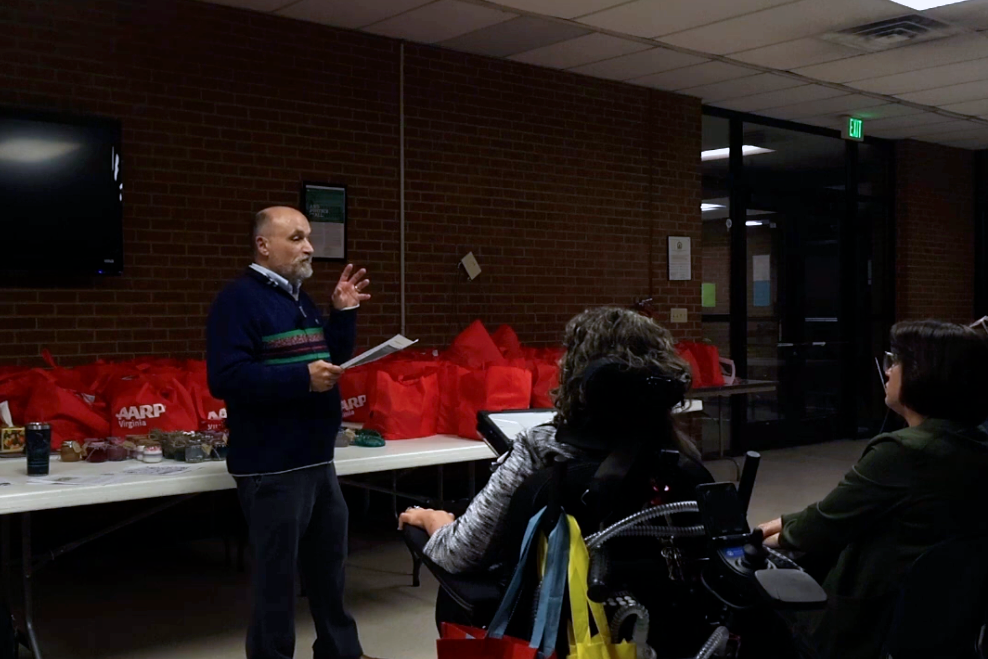
Author and Professor Emeritus Michael Santos earnestly shared that insight with the audience at the outset of Roanoke Indivisible’s four-part “Teach-in” series, which kicked off in February at Melrose Towers in Roanoke and will continue in March and April.
“Teach-ins” have been a cornerstone of nonviolent activism since the civil rights movement, leveraging knowledge and empathy against systems of dysfunction. As the United States continues to spiral toward fascism, the importance of halting that slide and reversing the negative impacts on human dignity, community safety and economic livelihoods has rarely been greater in modern America.
Santos’ session, titled, The Current Government Crisis and Pathways Forward, examined the cost of the regressive system that we find ourselves in today. His presentation devled into the decades-long events that led to this transformation — the “roots” of the problem, as he called it. But then he took the next vital step: He challenged every one sitting in that room to do more. It became a call to action that is desperately and immediately needed, one that prioritizes real action, changing the dynamic of society and not relying on mere performative activism.
Throughout the evening, Santos made this first Teach-in more than a lecture — it was an opportunity for the audience to share their perspectives, their reactions and their understandings of how America shifted to the brink of where it now stands. Forty years ago, he noted, GOP President Ronald Reagan played into the aspirational sense of the “American Dream” but also showed little of substance in his promises.
It’s probably no surprise that today, with another actor-turned-president leading this nation, political shallowness and reactionism persists, luring in many of those who don’t have the tools or foresight to grasp the path our government is steering us on.
“We begin to confuse reality with Hollywood, with celebrity. And the more we do that, the more we lose grasp on what reality is,” Santos said. “It goes a long way to explaining where we are today.” But what President Donald Trump is doing differently than Reagan is, instead of aspirational imagery of American fortitude and strength, he is pressing the viewpoint that everything external — immigration, free speech, the economy — is rotting. Trump then reinforces the idea that the state of the nation under previous leadership left us hopeless and unable, as individual Americans, to achieve what we set our minds to.
Santos countered this mindset by channeling the intensity and spirit of the nation, that we as a people need to hold accountable our leaders and expect them to live up to promises that are grounded in reality and necessity and justice.
A lot of the issues we’re experiencing today, Santos noted, can be traced back to deregulation of the Federal Communications Commission, which spurred corporate funding into media and the erosion of many “fair and balanced” outlets (no matter how emphatically outlets tried to press their “fairness” and “balance” upon their readers and viewers).
Contrarianism, which many budding outlets and social-media-savvy influencers subscribe to, isn’t inherently truthful just because it goes against the mainstream.
This relatively new relationship between media and business has played well into Americans’ growing sense of “freedoms,” where free markets and free speech felt like the natural extension of American ideals. Yet, under this umbrella, we were not as free as we believed, and this profit-driven approach to newsgathering and sharing cripples our nation’s foundation.
“Capitalism as the salvation of all things runs counter to what it is we also believe in: a nation of, by and for the people,’ Santos observed.
This new movement then spilled into the political sector, where lobbying intensified, corporate spending for candidates increased, and the way our government functions (almost literally) turned on a dime.
Santos was hitting on topics that are relevant and timely, as well as that which is most poignant in our current political climate.
Perhaps most importantly, he’s not just talking to one side of the political aisle: He’s talking to all of us.
To stay part of the conversation, please attend Roanoke Indivisible’s upcoming sessions. Here is more information:
Session 2: Making an Activist Business Work for Society & Investors
When: 6 to 7:30 p.m. Tuesday, March 24
Where: Virginia Tech, Robeson Hall, Room 210, 850 W. Campus Drive, Blacksburg
Instructor: Former Ben & Jerry’s and Stonyfield CEO Walt Freese
Session 3: Home and Family in a Fractured America
When: 6 to 7:30 p.m. Monday, April 6
Where: South County Library Auditorium, 6303 Merriman Road, Roanoke
Instructor: Author and 6th District Congressional Candidate Beth Macy
SESSION 4: Sustainability: Regenerating the Future
When: 6 to 8 p.m. Tuesday, April 28
Where: Virginia Tech (exact location TBD)
Instructor: Panel discussion